Contovista
2025
Help businesses better understand their financial health
I led the end-to-end design of Financial Key Metrics for Contovista's AI-powered Business Finance Manager, transforming complex transaction data into actionable financial guidance for thousands of small businesses using digital banking. Validated through two rounds of research showing faster comprehension and higher confidence in financial decisions.

Role
Team
Industry
Finance, AI, B2B2C
Skills
Product Design
UX Research
Prototyping
Key signals
Qualitative research to validate direction
14 users across two research rounds validated the direction.
Prototypes to shape the final outcome
2 prototype directions tested to shape the final experience.
Usability testing taught us what mattered
Provide guidance to businesses in an accessible and viable way.
Overview
Users knew what they needed, but the challenge was displaying it clearly.
After several months of research, prototyping and collaboration across Product, Engineering and Data teams, we introduced Financial Key Metrics, a new capability inside Contovista's Business Finance Manager that helps micro to small businesses understand their financial situation without requiring accounting expertise.
Solution
An interface that gives to businesses clear information and guidance about their finances, resulting in better confidence.
More control, without the complexity
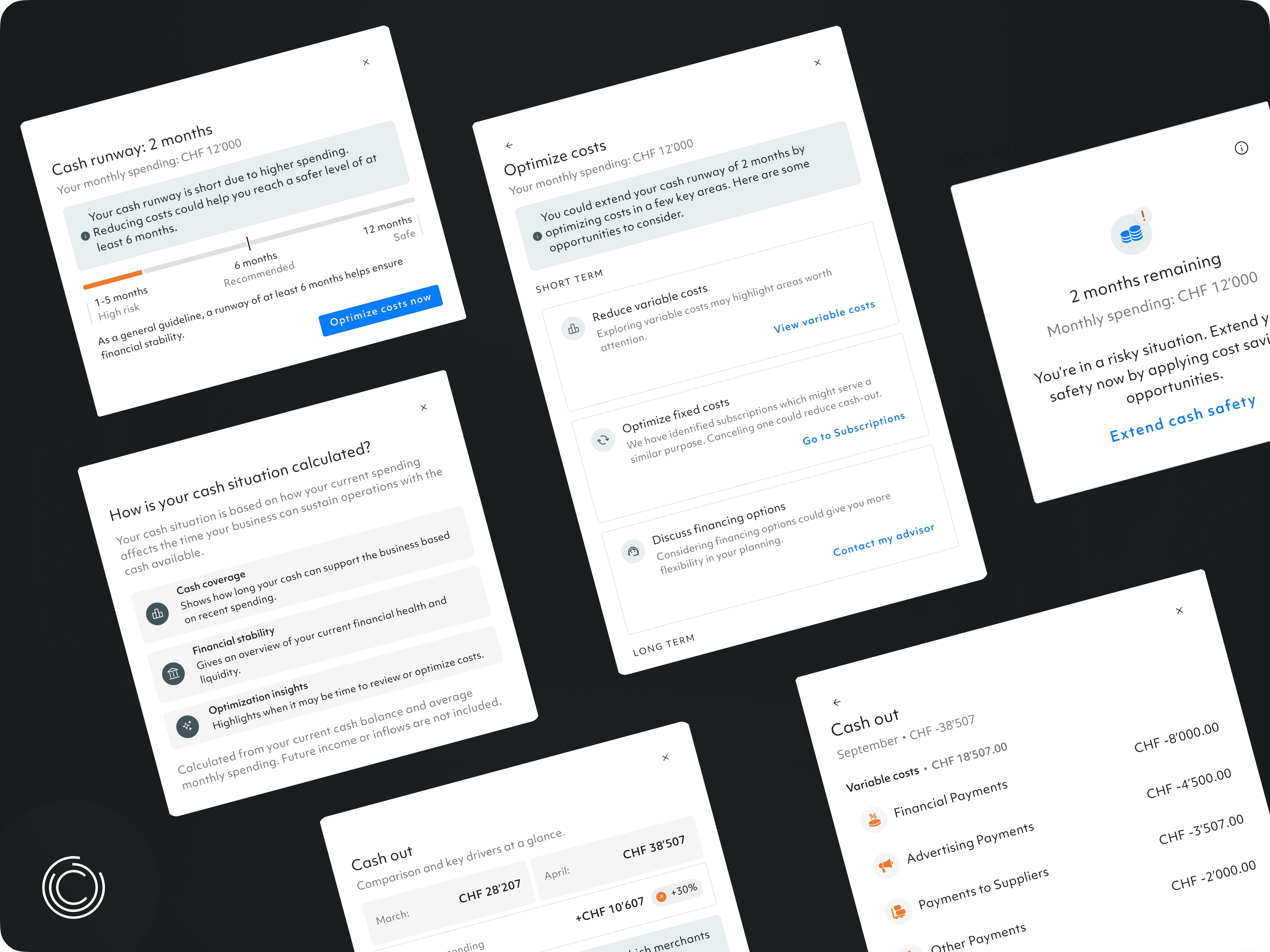
Cash Runway
Users see at a glance how long their cash will last, with clear thresholds (risky, recommended, stable) and the option to take action if needed, taking advantage of a list of recommendations provided.

Clear signals
High cash out detection
When monthly cash out is significantly higher than the previous month (increased >20%), users get a clear, high-signal notification that links directly to the costs that caused it.

Why it mattered
Throughout research while working on the BFM Strategy revealed a crucial information: users don't lack data, they lack understanding of it. Bank transactions told them what happened, but not what it meant. Owners couldn't easily answer questions like "is my cash position healthy?" or "are my costs trending the wrong way?" without exporting data and building their own views.
How might we
help businesses understand their financial situation, given their limited financial literacy?
Constrains & challenges
Lack of financial expertise
Dashboard and Analytics showed pure numbers, leaving interpretation to the business.
Limited user access
No direct contact with end users, constrained budget and no dedicated research resources.
Lean team, fast deadlines
Research and prototyping had to fit a tight timeframe without compromising the quality of findings.
B2B2C complexity
The product lives inside partner banks' environments. Decisions had to work across interfaces, within Contovista's system.
My process
1
User Research: Acquire Knowledge
I ran 1:1 sessions to map how small business owners currently track financial health: which tools they use, which metrics they monitor and where their understanding breaks down.
2
Secondary Research
I conducted Competitors Analysis and used external sources, including Harvard Business School studies and Federal Reserve data on small business financial literacy to pressure-test assumptions.
3
User Research: Metric Prioritization
A second round to validate which metrics would be most meaningful and actionable, giving the users the chance to do card sorting and motivate their selection. This directly informed which candidates to take into prototyping and which to cut.
4
Prototype Testing
Test and assess whether users can interpret and understand metrics at a glance, trust what they see and engage naturally with alerts, in-depth data. As well as eagerness to return regularly, building the habit.
Cross-functional collaboration
After each round I synthesised findings into shared documents and ran structured reviews with the Product Manager and Engineers, aligning the team on priorities before moving to the next iteration. I collaborated with the Product Manager to prioritize the metrics and map them cross checking data and technical feasibility.
Conclusions
The decision that shaped the outcome
Looking back, the success of the project didn't come from individual screens. It came from a handful of product decisions that changed the experience. We stopped reporting data and started explaining it.
Instead of asking users to interpret financial metrics themselves, every insight explains what happened, why it matters and when attention is required.
Looking back
Research consistently showed that participants understood financial concepts faster, trusted the information more and felt significantly more confident making decisions. For me, the project reinforced something that continues to shape how I design products today.
People rarely need more information. They need help understanding the information they already have.
Designing Financial Key Metrics wasn't about building another dashboard, it was about designing confidence.
Design System contribution
The components used for Financial Key Metrics were added to Contovista's design system, giving the team a reusable foundation for future data-heavy features.
Designing Financial Key Metrics wasn't about building another dashboard, it was about designing confidence.